Training in the Heat: Why Temperature Doesn’t Tell the Whole Story
“It’s not just the heat… it’s the humidity.”
Yeah, yeah…. we’ve all heard it. But when it comes to training, there’s a lot of truth behind it.
I recently saw a local news segment discussing changes to athletic practices, including adjustments to practice times, length, and intensity based on the Wet Bulb Globe Temperature, better known as WBGT.
As an ultrarunner training through Oklahoma summers, I’m pretty familiar with WBGT. Judging by the comment section, however, it seemed like there was some confusion about what it measures and why coaches should take it seriously.

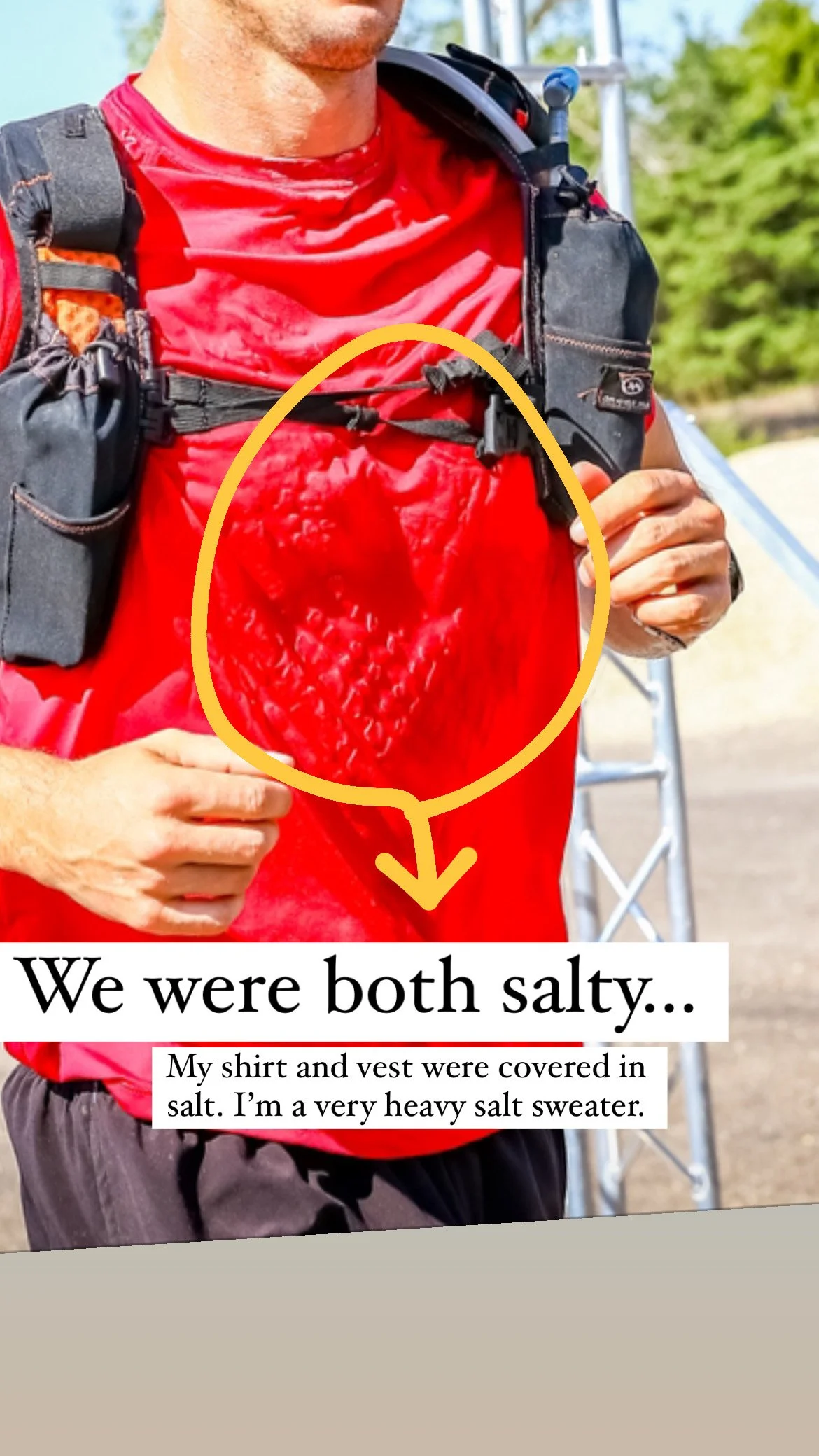
The photos above were taken during a 100-mile trail race, 10,000ft climbed ,and a heat index hit well into the 100s. Little breeze, no shade. Managing effort, pace, and hydration was good enough for 3rd overall.
Sweating Doesn’t Automatically Cool You
Sweating alone doesn’t cool your body. Sweat has to evaporate from your skin to remove heat.
When you exercise, your muscles produce heat. Your body responds by sending more blood toward the skin, allowing some of that internal heat to escape. You also begin sweating…but the cooling occurs when that sweat evaporates.
Air movement helps evaporation by moving humid air away from your skin. However, when the surrounding air is already holding a lot of moisture, sweat cannot evaporate as efficiently.
It may pour off you, soak your clothes, and make it look like your body is working overtime, and it is, but that sweat isn’t providing the same cooling effect.
High humidity essentially limits one of the human body’s greatest cooling tools.
What Does WBGT Measure?
The temperature shown on your weather app tells only part of the story.
The heat index considers temperature and humidity, generally assuming shady conditions. WBGT provides a better picture of heat stress during outdoor activity because it also accounts for sunlight, radiant heat, and air movement.
WBGT considers:
Air temperature
Humidity
Wind and air movement
Direct sunlight and radiant heat
Sun angle and cloud cover
That means a sunny, humid, windless 90-degree day can stress your body much more than air temperature alone suggests.
This is especially important for runners, outdoor workers, military personnel, and athletes practicing on fields that absorb and radiate heat.
WBGT doesn’t tell you whether you’re mentally tough enough to continue. It shows how hard the environment makes it for your body to control its temperature.
Acclimation vs. Acclimatization
You may hear two similar terms when people discuss heat training.
Heat acclimation refers to adaptations created through repeated exposure in a controlled environment. This might include an environmental chamberdly chamber or carefully planned sauna or hot-water immersion sessions.
Saunas and hot baths can be useful tools, but they should follow an intentional protocol. This isn’t the time to wing it, especially with hot-water immersion. The bathtub is a bad place to discover that your legs have turned into noodles.
Heat acclimatization happens by gradually training in the actual outdoor conditions you’re preparing for. This should be a systematic approach like any fitness program.
Both methods expose the body to heat stress, but acclimatization also provides experience with the sunlight, humidity, terrain, and wind you’ll encounter outside.
How the Body Adapts
With repeated and gradual exposure, the body can become better at managing heat.
These adaptations may include:
Sweating earlier and more efficiently
Expanding blood-plasma volume
Improving blood flow to the skin
Producing more dilute sweat, which helps conserve sodium
Experiencing a lower heart rate and core temperature at the same workload
Feeling less distressed while performing in the heat
These changes develop over time. One miserable afternoon in the Oklahoma sun isn’t heat training…. it’s just one miserable afternoon in the Oklahoma sun.
Acclimatized Does Not Mean Invincible
Heat acclimatization improves your ability to handle the conditions, but it does not remove the danger.
Even experienced athletes need to consider the WBGT and adjust accordingly. Depending on the conditions, that may mean:
Slowing your pace
Shortening the workout
Reducing the intensity
Moving the session earlier
Taking longer or more frequent breaks
Choosing a shaded route
Adjusting fluids and electrolytes
Ending the workout altogether
Your normal pace may feel harder because it is harder. More blood is being directed toward the skin for cooling, your heart is working harder, and fluid loss can add even more cardiovascular strain.
Trying to force your normal pace in abnormal conditions doesn’t prove fitness. It can turn a productive training day into a dangerous one.
Dizziness, unusual weakness, nausea, headache, confusion, loss of coordination, or a major change in behavior should never be treated as a test of toughness. Stop the activity, begin cooling, and get help when needed. Confusion, collapse, or altered mental status can signal a medical emergency. I saw this many times it my time in the Army.
Heat training can be useful, but it needs to be approached like every other type of training.
Start gradually. Allow your body to adapt. Adjust for the conditions. Leave the ego at home.
If you use training in the heat as “mental toughness” training, you’re wrong. It’s a tool to increase performance, but used incorrectly, it can have the opposite effect.
Respect the heat and take the Long Road.